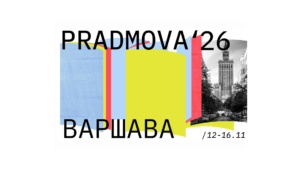
November 12-16, 2026: PRADMOVA Festival in Warsaw (program)
30 min read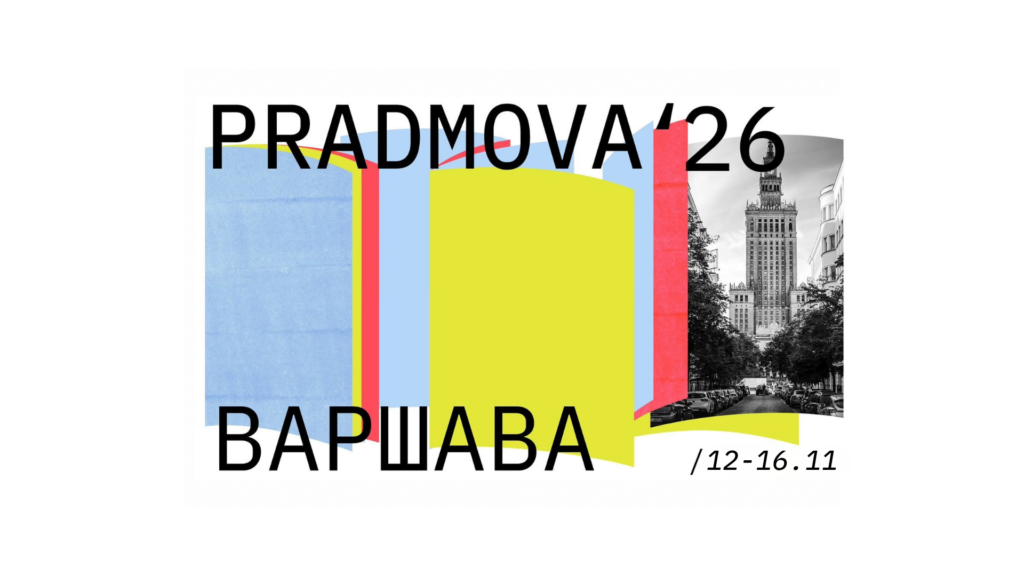
Warsaw · 12–16 November 2026
Five days.
Books, people, ideas.
PRADMOVA 2026 — author meetings, book launches, discussions, workshops, a children’s programme, music and theatre.
Venues and addresses
- Dom Spotkań z Historią
ul. Zielna 39, 4th floor · View map ↗ - Museum of Free Belarus
Foksal 11 · View map ↗ - Ursynowskie Centrum Kultury „Alternatywy”
ul. Indiry Gandhi 9 · View map ↗ - St Alexander’s Church
Plac Trzech Krzyży · View map ↗
Admission and registration
Admission to most festival events is free. Tickets are required for the Filamaty show. Buy tickets ↗ Please check individual event descriptions for admission conditions and registration links.
Book fair
The book fair will feature publishers Gutenberg, RozUm Media, Kamunikat, Mianie Niama, Polackija Labirynty, Vesna, hochroth Minsk, Januszkiewicz, Skaryna Press and SayBeat, as well as books from Surma, Lingua.by, Bukinist:ka, Pflaumbaum, Lohvinau and others.
Festival programme
Choose a date from the menu and find your venue. Each event is followed by its description and information about the participants.
12 November · Thursday
Ursynowskie Centrum Kultury „Alternatywy”
ul. Indiry Gandhi 9 · View map ↗
19:00 Filamaty: a musical and theatrical presentation.
Filamaty is a project by Belarusian artists from the bands Relikt and Syndrom Samazvanca, combining rock music, poetry, theatre, video projections and light.
Uladz Liankevich’s lyrics draw parallels between the lives of members of the secret Philomath Society in the 19th century and the experiences of Belarusian students who have challenged the system in our own time. The creators tell a contemporary story of youth, freedom, solidarity and emigration, exploring connections between events two centuries ago and Belarus today.
Featuring: Filamaty (Ales Dzemidzenka, Uladz Liankevich, Zmitser Narkevich, Vital Makshun); the Mara children’s choir of the Mikola Ravenski Belarusian School of Arts, conducted by Darya Dziatko; actors Katsiaryna Aleinikava, Mikhas Zui, Aleh Harbuz and Aliaksei Burnosenka.
The band’s album is available on digital music platforms. Listen to the album ↗
Tickets for the Filamaty show: Buy tickets ↗
Exhibitions · 13–15 November
Dom Spotkań z Historią
ul. Zielna 39, 4th floor · View map ↗
ArtPRADMOVA Space A
An exhibition of work by participants and shortlisted artists in the ArtPRADMOVA competition. Organised by the PRADMOVA festival.
Interwoven. A Conversation with “Ruins of Belarus” Space A
This installation is a dialogue with a book. The photographs come from its pages; alongside them are materials and discoveries that do not appear in the book. Ruins are what remains of buildings. But ruins are also what remains between images, memories and objects. The installation can be viewed from both sides, and visitors can leaf through the book and the accompanying materials. Organised by PRADMOVA and VEHA.
PrisonArt Space A
A gallery and archive of drawings by Belarusian political prisoners imprisoned following the 2020 presidential election and events in subsequent years. The works were created in pre-trial detention cells, open correctional facilities or penal colonies, then sent to the outside world. The Viasna Human Rights Centre collected these works from public sources, believing it important to preserve them together as part of the history of Belarusians’ struggle for freedom, democracy and human rights.
Organiser: Viasna Human Rights Centre. Curator: Artsiom Zadrutski.
13 November · Friday
Dom Spotkań z Historią
ul. Zielna 39, 4th floor · View map ↗
17:00–17:50 Official opening of PRADMOVA in Warsaw.
A performance by the Mara children’s choir of the Mikola Ravenski Belarusian School of Arts, conducted by Darya Dziatko. Opening remarks from PRADMOVA’s organisers and partners. Announcement of the winners of the Shufliadka competition. Hosted by Krystsina Drobysh.
18:00–19:00 Discussion: “The Classics We Did (Not) Choose: Who Shapes the Belarusian Literary Canon, and How?”
How is the Belarusian literary canon shaped today, and what roles do different actors play in that process? Is there room for translated literature within it, and who decides which works deserve to become part of the canon?
Participants: translator and publisher Siarhei Shupa, publisher Valiantsina Andreyeva, and literary scholar Tsikhan Charniakevich. Moderator: Maryna Kazlouskaya.
19:10–20:10 Launch of Uladzimir Niakliayeu’s collection of dramatic poems “Litviny” (The Litvins).
A meeting with Uladzimir Niakliayeu, with dramatic readings by Katsiaryna Vadanosava and Vasil Kalach. Moderator: Andrei Khadanovich.
20:30 “THE GRAY HOUSE” BOOK RAVE with PapaBo.
Every book has its own music. Sometimes you can hear it only once you step inside. Mariam Petrosyan’s “The Gray House” is a cult novel that created an entire universe with its own laws, characters, secrets and mythology. A House you do not want to leave, even after closing the final page. At PRADMOVA, we will try another way into this universe — through electronic music. With PapaBo at the decks, expect a full DJ set, a dance floor and a journey into a place where reality meets imagination. This event is for those who have already lived in the House and those still standing at its threshold. And if you have not yet read “The Gray House”, perhaps now is the time to discover the translation published by Gutenberg. The doors of the House are open.
14 November · Saturday
Children’s programme
Museum of Free Belarus (Foksal 11) · View map ↗
13:00–14:30 Introducing “Mouse and Dragon”, a new interactive platform for Belarusian fairy tales and games.
Create your own fairy tale — you do not have to be a writer! The new interactive platform for Belarusian tales and games, “Mouse and Dragon”, is a winning project from the Svae app’s “Build Your Own” initiative. You can create your own characters, including yourself, add familiar places, and set stories in a fairy-tale town, Minsk or Wrocław — or invent an entirely new world. You can add games to your stories and share them with friends. At the meeting, we will show you how to use the platform and what you can create. There will also be treats to share and a surprise we are keeping secret for now. The platform is designed for children aged 3–10 and adults of all ages. Hosted by Krystsina Drobysh.
14:45–15:15 Presentation of Natallia Holubeva’s “Learning Songs”
The songwriter will explain how the idea for these songs came about, share her creative process and show how the songs can help children grow up speaking Belarusian.
15:30–16:00 From the first letter to the first book: how to get children interested in Belarusian and reading.
How can we help children love the Belarusian language and reading without pressure or mechanical memorisation? At this meeting for parents of children aged 5–9, the author will share her experience of teaching her son to read in Belarusian in a Polish-speaking environment and present the alphabet book, cards and mini-books she has created. Participants will try playful activities, learn how to develop reading skills and support Belarusian in a multilingual family, and discuss ways to make reading together an enjoyable family tradition.
17:30–18:40 Launch of Tatsiana Bahdanava’s picture book “Out of Place”, about adapting to life in emigration.
The author will present her books and illustrations, explain the idea behind her new book about children adapting to forced emigration, and share interesting moments from its creation. Children and parents can take part in a workshop to make a small straw spider — the book’s protagonist — ask the author questions and enter a book giveaway. Moderated by Aliaksandra Hushcha.
Space A
Dom Spotkań z Historią (ul. Zielna 39, 4th floor) · View map ↗
11:00–11:50 “Belarus as a Lost Paradise”: a lecture and exhibition by Pavel Seviarynets.
How do you keep Belarus alive within yourself and your family when your homeland becomes unreachable and the surrounding world feels foreign? Drawing on his new book “Belarus Is Sacred”, Pavel Seviarynets will reflect on Belarusian identity, memory and a sense of homeland in imprisonment and emigration. Visitors will see original drawings he made in prison for his family, and hear poems performed by his wife Volha and son Frantsishak.
12:00–13:00 Launch of Elżbieta Smułkowa’s “Mówię ci, piesku… o Katyniu, Sybirze i naszym powojniu”.
Participants: Elżbieta Smułkowa, Valer and Tatsiana Kalinouski, and Rastyslau Khotsin.
13:10–13:50 “Half a Century in the Breach of History”: a book presentation about Zianon Pazniak (Kamunikat.org).
“Standing in the Breach” is an extended interview with Zianon Pazniak, spanning almost half a century of Belarusian history — from national revival and the struggle for independence to emigration — alongside personal memories and family stories. The journalists who conducted the interview will reflect on past events and how we understand them today, discuss the making of the book and reveal what remained outside its pages. A particular focus will be Belarus as remembered by a man who has spent much of his life observing it from afar.
Participants: Paval Mazheika and Zmitser Hurnevich. Moderator: Yaraslau Ivaniuk.
14:00–15:10 Discussion: “Memory Culture: How Belarusians Reclaim Their Past and Strengthen Their Identity”.
How do Belarusians preserve and reinterpret memories of the past, and how do these memories influence identity? We will discuss who shapes historical narratives and how, and the roles played by state institutions, culture, education and civic initiatives. We will explore how to address a traumatic legacy without reducing history to losses and defeats, how to pass memory on to future generations, and what image of Belarusians we create through our understanding of the past.
Organised by the Nation of Leaders educational hub. Participants: Ihar Stankevich, Tsimokh Akudovich, Siarhei Budkin and Pavel Matsukevich. Moderator: Maryna Kazlouskaya.
15:20–16:20 Presentation of the anthology “The Chernobyl Generation. Women’s Voices from Belarus and Ukraine” (Pflaumbaum)
For some, Chernobyl is already history; for others, it remains part of their family, body and memory. How do we speak about it forty years on? What do we pass on to those born afterwards? To mark the fortieth anniversary of the Chernobyl disaster, Pflaumbaum has published the anthology “The Chernobyl Generation: Voices from Belarus and Ukraine”. It brings together texts by fifteen Belarusian and five Ukrainian women writers, approaching Chernobyl through personal, family and collective experience. We will discuss how memories of the catastrophe live on in literature, how to write and speak about it today, and why these stories need to be told now.
Participants: toni lashden, Lesia Pcholka and Kasia Chekatouskaya. Moderated by Maryia Lapo.
16:30–17:30 Discussion: “The Lives of People in the Białystok Region as Part of Belarusians’ Shared History”.
Why did the traumatic experiences of Belarusians in the Białystok region remain outside the official historical memory of Poland and Belarus for decades? Drawing on Aneta Prymaka-Oniszk’s “Kamienie musiały polecieć. Wymazana przeszłość Podlasia”, we will discuss exile, post-war resettlement, violence and silenced family histories. The author, translator Natallia Rusetskaya and editor Nina Barshcheuskaya will consider how to bring forgotten chapters of the past back into shared Belarusian historical memory, and the roles literature, reportage and translation can play.
Moderator: Mikola Vauraniuk.
17:40–18:20 “Khvilinka” (A Moment): a novel as refuge and journey
A conversation with the author about a book you can wander into for a cup of coffee — and stay. Journeys through cities and eras: Minsk and Warsaw, Berlin and Vilnius, the 1980s and the present day. Characters whose lives intertwine, and an author who sees himself reflected in them. The occasion is the publication of the complete, revised version of “Khvilinka”, with the addition of “Three Conversations on Lutheran Hill”, in which the characters explain the meaning of the book to its author.
18:30–19:30 Conversation: “Erase or Preserve? Belarusian Theatre in Search of Its Place”.
What happens to a national theatre when it loses its stage and its artists face attempts to erase them from history? How has Belarusian theatre changed over the past decade, and what shapes its life today?
Having read each other’s books, “Kupałowcy. Teatr narodowy na wygnaniu” and “(Not) Erased: Belarusian Theatre 2015–2025. Selected Pages”, theatre scholars Iryna Lappo and Nastassia Pankratava will reflect on the losses and achievements of Belarusian theatre, new productions, artistic exploration and relationships with audiences. They will also discuss whether a theatre in exile can remain a national theatre, and what the future of the Belarusian stage might look like.
20:30 Concert by Nocne ptaki.
Nocne Ptaki is an independent music project bringing together four artists from different musical worlds: opera, post-punk, disco, electronic music and jazz. Their work boldly combines different aesthetics, powerful sound, emotion and experimentation. Unrestricted by genre, they create a distinctive artistic language of their own. Their concerts are more than musical performances: they are music-and-theatre experiences where music meets theatre, visual art, striking costumes and masks. Polish and Belarusian cultures intertwine in their work, with identity, freedom, love, diversity and everyone’s right to be themselves at its heart. Nocne Ptaki create their own world — bold, unusual, full of energy and open to everyone.
Band members: Volha Shnip (vocals), Stas Murashka (drums), Filip Petchanka (bass) and Stanislau Chakhouski (keyboards).
Space B
Dom Spotkań z Historią (ul. Zielna 39, 4th floor) · View map ↗
11:00–11:50 “Giggles and Chuckles”: a collection of contemporary feminist writing on humour.
Can we laugh at serious matters and find humour in everyday life? “Giggles and Chuckles” is a collection of feminist texts about love, work, migration, family, motherhood and other adventures, created by participants in the Rasciazhennie archive’s writing laboratory. The authors will discuss making the book, share the secrets of literary humour and reflect on turning personal experiences into funny stories.
Participants: Valeryya Vaukahonava and Khania Rahachouskaya. Moderated by toni lashden.
12:00–12:40 “The Gardener’s Manifesto”: how do we plant a garden for the future? Presentation of Tania Artsimovich’s new book (Pflaumbaum)
“The Gardener’s Manifesto” is a book by Belarusian researcher, art critic and curator Tania Artsimovich. It tells the story of a woman whose life was fractured after 2020 and who must now put herself together again. She would envy trees, but she will never take root in a new place; instead, she envies grey herons. She decides to grow a garden “at the edge of the world and history”, refusing to wait passively for a better future. In this literary and cultural essay, Artsimovich turns to her own roots to ask what that better, radically different future might look like: a future that would end an era of social domination and inequality. Is a society possible that does not rely on humans exploiting other living beings and resources? How can we bring such a future about? The “garden on the edge” becomes a realised utopia — a fragment of the universe where “mobilisation through poetry” is possible, where an active “I” challenges a vague “we” and takes responsibility “for the garden it tends”.
With author Tania Artsimovich. Moderator: Nasta Karnatskaya.
12:50–13:30 “The One Who Gives Names”: presenting the new novel by Aliaksandr Karnaukh (Gutenberg)
What lies hidden in the past of our part of Europe? Which stories have vanished from memory yet continue to shape the present? Following his debut novel “Cold Lands”, shortlisted for the Giedroyc Prize, Aliaksandr Karnaukh returns with a new book that seeks to create an unusual epic on the boundary between history, myth and forgotten traditions. The author will reveal some of the new novel’s secrets, discuss his sources of inspiration and perhaps offer keys to reading it.
With author Aliaksandr Karnaukh. Moderator: Maryna Kazlouskaya.
13:40–14:10 Publishing Basics: Answers for Anyone Who Wants to Publish a Book
How does a manuscript become a book? Where should an author begin, how can they find a publisher and prepare a text for print, and what should they know about costs, copyright and distribution? Publisher Andrei Yanushkevich will explain how contemporary Belarusian publishing works, share practical advice and answer questions from those dreaming of publishing their first book.
14:20–15:00 The anatomy of scandal. How do you become an inconvenient voice?
Can you find your own path in literature without submitting to authorities, publishing hierarchies and the rules of the literary world? Pavel Antsipau and Tsimur Kudzelich will reflect on writing outside the mainstream, freedom from recognition and prizes, success on the margins and the price of independence. They will also ask why a writer might choose to remain outside the system.
15:10–15:50 A “Book of Optimism” by Uladzimir Arlou.
“Names of Freedom”: 450 new stories of Belarusian dignity and hope
Who were the people who fought for Belarusian freedom and independence in different eras? Uladzimir Arlou will present the second part of “Names of Freedom”: 450 new literary and historical portraits that restore little-known heroes and their lives to our memory. The author will discuss his work on the book, the search for forgotten stories and why he calls the project a “book of optimism”. A separate theme will be emigration and the memory that helps preserve ties to one’s homeland even from far away.
With author Uladzimir Arlou. Moderator: Yaraslau Ivaniuk.
16:00–16:40 More than one history: women’s, national and personal perspectives in Kristina Sabaliauskaitė’s “Silva Rerum” (Vesna)
Who tells history, and does it change depending on who looks at the past? In Kristina Sabaliauskaitė’s historical series “Silva Rerum”, the events of the 17th and 18th centuries unfold through private lives, family relationships and personal choices. We will discuss women’s perspectives in historical fiction and what they reveal beyond wars and high politics. Together with Belarusian translator Siarhei Shupa, we will ask who the heritage of the Grand Duchy of Lithuania belongs to, how contemporary Lithuanian authors interpret it, and what changes when this history begins to speak Belarusian.
With translator Siarhei Shupa. Moderator: Maryna Kazlouskaya.
16:50–17:30 Presentation of the comics collection “Through the Bars” (Viasna Human Rights Centre).
Thousands of people have experienced political persecution in Belarus. Political prisoners, their relatives, friends and people who care have written tens of thousands of letters. Many letters written in detention never reached us because of censorship, bans and repression. This collection imagines what letters sent by political prisoners from behind bars, rather than letters addressed to them, might look like. It brings together four stories by former political prisoners for whom drawing was a way of making sense of their own imprisonment. Different in style and mood, each truthfully conveys daily prison life: cold cells, meaningless rules and harsh guards — but also friendship, support and small pleasures that help people endure. There is room in these stories for hope and faith in the future. Letters can be stopped, but every page reminds us that solidarity is stronger than repression.
Participants: Maryna Kastylianchanka, Mikita Sennikau and Ales Papkovich.
17:40–18:30 Fifteen Women’s Lives: presenting a book about the wives of political prisoners
A book about their waiting, loneliness, fears, intimacy and daily struggle for themselves and their families. “Invisible: The Wives of Political Prisoners”, the new book by Volha Vialichka, is based on conversations with women whose husbands were imprisoned for their beliefs. With the author, Volha Vialichka.
18:40–19:30 How and why should we engage with traditional culture today?
Yauhen Baryshnikau — musician, cultural manager, researcher of bagpipe traditions, exhibition curator and dance organiser based in Gdańsk.
19:40–20:20 FSH1 Library: a collection of Belarusian photobooks in Warsaw
Yauhen Attsetski, co-founder of FSH1, will introduce the FSH1 Library project and the photobook as a medium. He will discuss how photographers use this format to address personal and socially important subjects, how photobooks help bring Warsaw’s photography community together, and how one photobook helped make Belarusian issues more visible within Poland’s professional community. FSH1 Library is a publicly accessible collection of art books and photobooks by Belarusian authors in Warsaw. The project also hosts a Photobook Club where people discuss important social and cultural issues connected with Belarus.
Space C
Dom Spotkań z Historią (ul. Zielna 39, 4th floor) · View map ↗
11:00–11:50 Tracing the avant-gardes in Belarus. Writing another history.
Did the history of the Belarusian avant-garde end in the interwar years, or does it still influence art and culture today? Drawing on her new book “‘We Are Like Those Foremothers’: Traces of Avant-Gardes in Soviet Belarus”, researcher and curator Tania Artsimovich will discuss connections between the avant-garde of the 1920s, nonconformist art of the 1980s and contemporary artistic practices. We will explore forgotten names, the rethinking of artistic canons, and the place of the Belarusian avant-garde within European cultural history.
With Tania Artsimovich. Moderator: Volha Mzhelskaya.
12:00–13:00 The Ukrainian shelf at hochroth Minsk: Belarusian translations of new Ukrainian poetry.
Can poetry bear witness to war, become a form of resistance and express solidarity? hochroth Minsk will present four books of Ukrainian poetry in Belarusian translation, by Serhiy Zhadan, Yuriy Izdryk, Maksym Kryvtsov and Iryna Shuvalova. We will discuss wartime literature, its role in preserving memory and national identity, and translation as a way to support Ukraine and build cultural ties between our peoples.
Participants: Andrei Khadanovich, Natallia Rusetskaya, Volha Franko (online) and Ales Plotka. Moderator: Dzmitry Strotseu.
13:10–14:00 Presenting the essay anthology on neighbourliness “I Come to You, People” (Pflaumbaum).
Who are our neighbours — those who live next door and those we discover across borders? What do we know about them, and what do they tell us about ourselves? The anthology “I Come to You, People” explores neighbourliness in both its broad and narrow senses. It brings together essays by eighteen contemporary Belarusian women writers: those who have remained in Belarus and those forced to leave after 2020 as political repression intensified. They reflect on how we feel among people from other cultures or people like ourselves, how we see and influence one another. They explore what neighbourliness gives us: an understanding of everyday life and ways of communicating, and a sense of our own identity formed in Belarus. We will discuss what it means to be a neighbour today, when borders divide some people while language and literature bring others together.
Participants: Yuliya Artsyomava, Tania Artsimovich and Maryya Lapo. Moderator: Alena Piatrovich.
14:10–14:50 Presentation of Ihar Kulikou’s new book “City N.” (Januszkiewicz) and translations from Lithuanian.
Ihar Kulikou will present his latest poetry collection, “City N.”, about Minsk, Vilnius, Warsaw and other cities and towns encountered on his journey far from home. Less a collection of poems than a series of verbal photographs, it attempts to capture space and time: familiar places, to resist the inevitable estrangement of life away from one’s homeland; unfamiliar ones, to inhabit them and make them feel closer — not to claim them, but at least to make them more welcoming. The collection includes one translation: “Return” by Lithuanian poet Henrikas Radauskas. At the meeting, it will be expanded into a whole sequence of translations from Lithuanian on which Ihar is currently working.
15:00–16:00 Profession: hope. How to keep the horizon in sight and create meaning.
Can we learn to create hope for ourselves, for others and for society as a whole? The starting point will be the Belarusian translation of philosopher Byung-Chul Han’s “The Spirit of Hope: Against a Culture of Fear”, which presents hope as an active force capable of changing reality. Former members of the strategic communications team at Sviatlana Tsikhanouskaya’s Office and StratComLab will share their experience of working with public sentiment and visions of Belarus’s future after 2020. We will discuss how to sustain hope in times of crisis, where to find new meaning, and whether the “craft of hope” can become a set of practices available to everyone.
Participants: Nasta Rahatko, Anastasiya Kastsiuhova and Aliaksandra Lohvinava.
16:10–16:50 Meet the writer: Stas Ilyin. Presentation of “Reflections of K” (RozUM Media).
Why does a writer move away from realistic prose and personal experience towards fantasy and literary experimentation? Is it an escape from reality, a form of inner emigration or a natural creative evolution? We will discuss the boundaries between autobiography and invention, the search for new literary forms, and how sound, rhythm and breath change our perception of a text.
Participants: Stas Ilyin and Vasil Kalach. Moderator: Pavel Liahchylau.
17:00–17:40 Presentation of VEHA’s “Ruins of Belarus”.
The book catalogues the ruins of Belarus — scars that preserve the memory of interrupted histories. Project curator Lesia Pcholka will discuss the VEHA archive’s working methods, the concept behind the publication and ways to join the next stage of the project. One of the book’s stories invites us to see ruins as unrealised possibilities through the history of the first known stone church in Minsk. Construction began on the bank of the Niamiha in the early 12th century, but the church was never completed. It remains a material trace of a future that never came to be. Taking this story as his starting point, artist Uladzimir Hramovich proposes seeing incompleteness as a state in its own right rather than reconstructing what was lost: a missing part does not necessarily need restoring, and an interrupted structure does not always require completion.
Please note: VEHA’s “Ruins of Belarus” will not be sold at the event, but it can still be ordered online.
17:50–18:40 Presentation of the print edition of contemporary poetry magazine Taubin.
How does contemporary Belarusian poetry live and develop, and what role do literary magazines play? To mark its fifth anniversary, the online magazine Taubin is publishing a print edition featuring poems, translations, interviews and literary criticism. Editors Darya Bialkevich, Artur Kamarouski and Hanna Shakel will present the issue, look back on the project’s history and discuss everyday editorial work, successes, challenges and plans.
18:50–19:30 A Ukrainian focus: “Sozh” and “Antares”, an anthology of Ukraine’s Executed Renaissance in Belarusian.
“Sozh” is the Ukrainian version of “Bloodlands 2020/2022 Belarus/Ukraine”, translated by Viacheslav Levytskyi, a friend of Belarusian culture. It is the first translation from Belarusian into Ukrainian since 2021 and continues the original’s humanitarian mission of collecting donations for clients of the Lanka rehabilitation centre in Ukraine. “Antares” is a bilingual anthology of Ukraine’s Executed Renaissance in Belarusian, bringing together works by 26 authors persecuted by the Soviet authorities. Following a successful crowdfunding campaign, part of the print run is already available and will be presented exclusively at the festival.
You can order your copy on the Gronka platform until 29 November.
Featuring Ales Plotka, co-author of the first book and editor of the second.
15 November · Sunday
Workshops · Space A
Museum of Free Belarus (Foksal 11) · View map ↗
12:00–13:45 Poetry workshop with Valeryya Vaukahonava.
Can you write a poem even if you have never tried before? Participants will explore different poetry-making techniques, from association games to blackout poetry, and look for inspiration in other people’s texts and their own thoughts. Everyone will be able to experiment with words and create a poem. No previous literary experience is needed — just curiosity and a willingness to try!
14:00–15:00 Popular science! What is it?
How can science be made interesting and understandable to a broad audience? Who can communicate science, and why does it matter for Belarusian society, including in emigration? The team behind the popular science zine Pamylka will share three years of experience, introduce the Bizon Higgs award for Belarusian scientists, and invite an open discussion about the future of science communication in Belarusian. Recent issues of the zine will also be available to buy.
Participants: Sviatlana Volchak and Yauhen Piatlitski.
15:15–17:45 Nobody Wants a Sad Emigrant — a workshop by the Rastsiazhenne feminist writing laboratory
How can you turn a difficult, distressing or awkward experience into humorous writing without diminishing your own feelings? Writer Khania Rahachouskaya invites participants to see humour not merely as a way to make readers laugh, but as a literary tool for rethinking even the most challenging situations in life.
Using examples from Belarusian and international literature, with particular attention to women’s prose, participants will explore techniques for creating comic effects: self-irony, exaggeration and absurdity. In the practical session, they will turn a real or imagined situation into a literary plot, write short texts and discuss the results. Materials and exercises for independent work will be provided after the meeting.
The workshop is open to beginners and experienced writers alike. You may write in Belarusian, Russian or a combination of both. No previous writing experience is required.
Led by Khania Rahachouskaya. Moderator: Marni Vishneuskaya.
Workshops · Space B
Museum of Free Belarus (Foksal 11) · View map ↗
13:00–14:30 A fabric book cover.
Participants will make their own fabric book cover, protecting a book while giving it a distinctive look. We will work with fabric, textures and decorative elements so that everyone can create something unique by hand. Sewing skills are not required.
Led by Alesia Tarasenka, librarian at the Dolnośląska Biblioteka Publiczna in Wrocław.
15:15–17:45 A meeting of Kraków’s LITARALNA writers’ club: “What Stops You (and Us) from Writing?”
You want to write, but… it is not that simple! First you have to wait for the right mood, find the time, clear your desk, open a document or take a blank sheet of paper, write the first sentence, rewrite the first sentence, delete the first sentence. And then decide that nothing good will come of it anyway.
But what if you could simply write?
At this meeting, we will try doing just that together through playful writing exercises. We will explore what holds us back, what we expect of ourselves and our texts, and how to find the courage to share them with a reader.
Age: 18+
LITARALNA welcomes voluntary donations to support the club’s development.
Please bring whatever you prefer to write with, from notebooks to laptops. Writing languages: Belarusian, Russian and Ukrainian.
Space A
Dom Spotkań z Historią (ul. Zielna 39, 4th floor) · View map ↗
11:00–11:50 Anonymity in contemporary Belarusian literature.
Today, it is often impossible to name a book’s real author: some use pseudonyms, while others remain entirely anonymous. Is this a necessary precaution for their own safety and that of relatives in Belarus, or a new norm of literary life that we will have to live with?
The team at Lysy Charep will discuss how a publisher decides to work with an anonymous author, what changes in the relationship between writer, editor and reader when a name is unknown, and whether anonymity can be not just protection but a literary gesture in its own right.
Participants: Pavel Antsipau and Viachaslau Kmit.
12:00–13:20 History without archives? How can we research contemporary Belarusian history from abroad?
Can the history of contemporary Belarus be written when researchers are in exile and much of the archive remains inaccessible? Is it worth waiting for better times as documents disappear and witnesses pass away? The discussion will start with Viktar Shadurski’s “The Birth of the Belarusian Leviathan” and “The Land Beneath Grey Wings”, about the emergence of Belarus’s authoritarian political system. Viktar Shadurski, Aliaksandr Smalianchuk and Ales Pashkevich will discuss researching recent history with limited access to sources, how far personal memories and testimony can be trusted, and how to distinguish historical analysis from political commentary. They will also consider whether emigration can be an opportunity for independent reflection on the past as well as an obstacle.
Participants: Viktar Shadurski, Aliaksandr Smalianchuk and Ales Pashkevich. Moderator: Aliaksandr Parshankou. Organised by Kamunikat.org.
13:30–14:20 “Echoes of Home”: presenting the poetry collection by Katsiaryna Vadanosava (Kamunikat.org).
Can you lose your home yet keep it within you? Katsiaryna Vadanosava will present her new poetry collection “Echoes of Home”, illustrated by Aliaksandra Kanafalskaya. The author and artist will reflect on home, memory, loss and life between “here” and “there”. We will discuss how forced emigration changes creativity and a sense of belonging, and how poetry helps maintain a connection with a homeland to which returning is not yet possible.
Moderator: Ihar Palynski.
14:30–15:10 Presentation of Henadz Sahanovich’s “Mikola Prashkovich: The Story of a Belarusian Dissident”
15:20–16:10 “A Sign of Freedom” — a creative encounter with Maksim Znak: poems, songs and a conversation about creativity and new plans.
How does creativity change after ordeals that radically transform a life? Maksim Znak, known as a lawyer and former political prisoner, will appear before the audience primarily as a writer, poet and musician. We will talk about literature and music, irony and self-irony, experiences lived through and things one wishes to leave behind. Maksim will read his poems, perform songs, discuss new creative ideas and reflect on how an author’s voice changes after regaining freedom.
Maksim Znak; moderated by Tatsiana Niadbai.
16:20–17:20 A history of retail: where did goods disappear to from Soviet shop counters? How did Belarusians buy, sell and survive? (Januszkiewicz)
What can shops, markets and traders tell us about Belarusian society? VESNA will present the final volume of the three-volume monograph “A History of Retail in Belarus”, devoted to the 20th century. Researchers will explain how trade changed in Soviet and post-Soviet times, what happened outside the official economy, and how the history of everyday purchases offers a fresh perspective on Belarusian lives.
Participants: Iryna Makhouskaya and Siarhei Shupa.
17:40–18:20 The return of Chagall. How can “Svayo” (One’s Own) speak to us today? (Mianie Niama)
Why should “Svayo” be read for more than the name on its cover? Everyone knows Marc Chagall — a hashtag, a sticker, a T-shirt print: he is one of ours.
Publisher Pavel Antsipau and translator Siarhei Shupa will discuss why Chagall’s text remains alive today, what new things can be found in it, and why Belarusian readers need this book here and now. Certainly not just so its spine can look impressive on a bookshelf.
18:30–19:30 “Ales in Polish: The Story of a Man and Belarus’s Viasna” — presentation of the Polish edition of Ales Bialiatski’s “Ales”.
How does a personal biography become part of a country’s history? We will present the first Polish edition of Ales Bialiatski’s autobiographical book “Ales”, telling the story of the Nobel laureate’s life, the emergence of the Belarusian human rights movement and the history of Viasna. We will discuss the person behind the public image, personal choices, resistance and solidarity. We will also ask how to tell Belarusian history to Polish readers, what needs explaining and what can be understood without translation.
With Ales Bialiatski. Moderator: Tatsiana Niadbai.
Space B
Dom Spotkań z Historią (ul. Zielna 39, 4th floor) · View map ↗
11:00–11:40 From the archive of the Belarusian idea: Ihnat Abdziralovich and Uladzimir Samoila.
An attempt at a parallel — and apocryphal — reading of two legendary texts at the origins of Belarusian thought: Abdziralovich’s “Along the Eternal Path” and Uladzimir Samoila’s “By This You Shall Conquer”. I. B., poet, philosopher and traveller, searches for recipes and paradigms.
11:50–12:50 The death of the “Elephant”: plot is overrated. What do we look for in literature?
Is plot-driven prose really giving way to autofiction, literary experiments and games with form? Does that mean readers no longer need stories? Drawing on works by Eva Vezhnavets, toni lashden, Sasha Filipenko and Svetlana Alexievich, we will discuss changes in contemporary Belarusian literature, readers’ expectations and the blurring of boundaries between prose and poetry. We will also explore how writers seek new ways of telling stories and experiment with their own texts.
Participants: Viktsia Udovina (online) and Tsimur Kudzelich.
13:00–13:40 “Epic Liavon” — a meeting with Liavon Barshcheuski, translator of classical literature (Polackija Labirynty).
How can ancient Greek epic be made to speak Belarusian, and can all its grandeur be conveyed in a modern language? Liavon Barshcheuski will present his translation of Homer’s “Odyssey” and discuss his many years of work with classical literature. We will explore translation as both a craft and a creative adventure, the challenges of conveying ancient texts, and how world classics enrich Belarusian. We will also ask: why does today’s Belarusian reader need Homer, and why does Homer need Belarusian?
Moderator: Tatsiana Niadbai.
13:50–14:30 Presentation of Yana Hultsiyayeva’s “Linea lateralis” (Surma).
How is a first book born, and what journey does it take from idea to publication? The author will present her debut, discuss how it came into being, its main themes and visual design, and read selected passages. A particular focus will be the image of the homeland, feelings of belonging and otherness, and how these motifs take shape in the book. Visitors will be able to ask questions and join the discussion.
With author Yana Hultsiyayeva. Moderator: Tsikhan Charniakevich. Supported by the International Union of Belarusian Writers.
14:40–16:10 The speculative fiction lab: how to invent the future without getting lost (Gutenberg).
Artsiom Shukanau, whose novel “Pentakvantar” was shortlisted for this year’s Giedroyc Prize, and Yauhen Anashkin, author of “Noradrenaline”, both write speculative fiction but take very different approaches. Shukanau’s text spans a vast setting, alternates between three protagonists and lays solid foundations for an expanding fictional universe. Anashkin’s novel is linear, its world concise and its setting confined to a single, rather anonymous city. Yet each method serves its own creative purpose. Join the writers to discuss and compare their approaches and see first-hand how a novel takes shape.
Participants: Yauhen Anashkin and Artsiom Shukanau. Moderator: Aliaksei Kartynnik.
16:20–17:00 Presentation of Volha Siamashka’s “Cemeteries of the Belarusians of Podlasie”.
What can old gravestones tell us about the history, language and identity of the Belarusians of Podlasie? Researcher Volha Siamashka will present her book “Cemeteries of the Belarusians of Podlasie” and show how inscriptions, symbols and burial traditions can help reconstruct little-known chapters of the region’s history. This multimedia lecture will consider cemeteries not only as burial grounds, but as spaces of memory, evidence of the Belarusian presence in Podlasie, and places where cultural heritage is preserved across generations.
With author Volha Siamashka. Moderator: Tsikhan Charniakevich.
17:10–18:00 “Street of Charlatans”: Gałczyński in Belarusian (Gutenberg).
Belarusian poet and translator Andrei Khadanovich talks with Polish literary scholar and translator Adam Pomorski about the brilliant Konstanty Ildefons Gałczyński, marking the publication of his selected poems, “Street of Charlatans”. They will discuss what brought the poet bohemian fame before the Second World War and made him a widely loved cult figure afterwards; where he followed the rules of his time and where he was far ahead of it; why his irony and humour still make us laugh and his serious lyric poetry still moves us to tears — and whether the two can be separated at all. The discussion will be in Belarusian and Polish, with poems read in the original and in Belarusian translation.
Participants: Andrei Khadanovich and Adam Pomorski.
Space C
Dom Spotkań z Historią (ul. Zielna 39, 4th floor) · View map ↗
11:00–12:00 How do we write about Belarusian literature today?
How is Belarusian literature studied today, and what new approaches do literary scholars use? Drawing on four publications by the Theatre and Drama Research Unit of the Department of Belarusian Studies at the University of Warsaw, participants will discover current directions in literary scholarship, their methods and findings.
With Inesa Kuryan.
12:10–12:50 How do you find your people abroad and build a community?
How can you find your people abroad and turn a circle of acquaintances into a real community? Drawing on “Sociotechnics: Beginnings”, Mikhail Volchak will explain how communities emerge and develop, what invisible roles and rules shape relationships between members, and what helps sustain trust. We will discuss finding one’s place in a community, how influence is distributed, and how to build lasting connections that can grow into collective action.
13:00–13:50 “The Mountain Country: Imagined, Yet Strangely Familiar”.
Can you tell the story of a real country by inventing another? Siarhei Ablameika will present his short-story collection “The Mountain Country”, an ironic, absurd and sometimes sad chronicle of life in an imaginary country where Belarusian readers will easily recognise familiar realities. The author will explain how this literary world came into being, why its separate stories form a single whole, and how imagination and satire offer new ways of seeing Belarusian history, society and ourselves.
Participants: Siarhei Ablameika and Uladzimir Arlou.
14:00–15:00 Tracing the roots of Belarusian cuisine: everyday life, literature and recipes from the 19th century.
What was served at the tables of Belarusian noble households two hundred years ago? Where did unusual ingredients come from, who wrote down the recipes, and what can old cookbooks tell us about our past? Sviatlana Luhautsova and Maryna Kazlouskaya invite you on a culinary journey through Belarus in the first half of the 19th century. We will discuss forgotten recipes, the culinary legacy of Jan Szyttler, Anna Ciundziewicka and Wincenta Zawadzka, and how food and feasting appeared in literature. We will also explore how culinary history can help us rediscover Belarusian culture and our own family traditions.
Participants: historian Sviatlana Luhautsova and translator Maryna Kazlouskaya. Moderator: Aliaksandr Parshankou.
15:10–15:50 “Ukrainian Icon Painting”: poetic reportage from 2014–2025 by Dzmitry Strotseu, published by Kyiv-based Dukh i Litera.
Can poetry bear witness to historical tragedies and convey someone else’s pain? Drawing on a Belarusian author’s poetic reportage about Maidan and the war in Ukraine, we will discuss the power of literary language, a witness’s responsibility and the limits of artistic engagement with tragic events. Who are such works written for, how do they sound in Ukrainian translation, and how do Ukrainians themselves receive them?
Participants:
Dzmitry Strotseu — poet and author of “Ukrainian Icon Painting: Poetic Reportage 2014–2025”;
Nataliia Belchenko — Ukrainian poet and translator of Polish and Belarusian literature.
16:00–16:40 A conversation around Illia Kulbitski’s “A Chronicle of the Denial of Emptiness” (Skaryna Press).
Where does reality end and the fantastic begin? How do we find words for something that has not yet happened but can already be felt? Illia Kulbitski will present “A Chronicle of the Denial of Emptiness”, shortlisted for the 2026 Natallia Arsenneva Prize. We will discuss the search for invisible meanings, the interpenetration of the real and the imagined, creativity as a kind of magic, and the courage of those capable of making new worlds.
16:50–17:40 Author, Can You Hear Us? A conversation about reading clubs
Reading clubs are communities capable of influencing the literary process. Can readers change authors’ views, influence which books are published and shape demand for new literature? We will explore where reading ends and a real influence on the world of books begins.
Lilia Iliushyna; supported by Living Lab within the EU4Culture II programme.
St Alexander’s Church
Plac Trzech Krzyży · View map ↗
20:00 Poetic Cantata.
“Poetic Cantata” brings together contemporary Belarusian poetry and music by composer Volha Padhayskaya.
At the heart of the concert is a dialogue between words and music, with the poets and composer taking part in a shared creative process. The programme features Volha Padhayskaya’s works for solo organ and choral settings of poems by contemporary Belarusian poets. Music and poetry intertwine to create a single artistic space. What makes the project special is this creative exchange: the poets choose verses they feel resonate with organ music, and the composer brings their words to life in musical works. The authors will read their own poems; works by poets unable to attend will be read by children from the Mara choir. “Poetic Cantata” thus becomes a meeting not only of words and music, but also of generations, voices and creative worlds. Programme:
- Andrei Khadanovich reads a poem accompanying “Orgelzeit” for solo organ.
- Choral piece “And the Stars Above Her Are Golden”, setting a poem by Andrus Takindanh. The poem is read by Andrus Takindanh.
- Vital Ryzhkou reads “Lullaby for No One”, accompanying “Nocturne” for solo organ.
- Choral piece “My Vyrai”, setting a poem by Yuliya Tsimafeyeva. The poem is read by Miron Valodzin.
- Vera Burlak’s poem “Up High”, accompanying “Wings of Light” for solo organ. The poem is read by Malanka Trafimenka.
- A poem accompanying “Dreams Beneath a Blue Tree” for solo organ.
- Choral piece “The Sky Shares Its Thoughts”, setting a poem by Volha Hronskaya. The poem is read by Malanka Trafimenka. Soloists: Iryna Koval, Iryna Piven, Antanina Khrabenka and Malanka Trafimenka.
- Dzmitry Strotseu reads “This Is the Happiest Time” (translated by Andrei Khadanovich), accompanying “Toccata” for solo organ. Choral piece “Miracle”, setting a poem by Dzmitry Strotseu in Andrei Khadanovich’s translation. The poem is read by Dzmitry Strotseu.
Performers:
The Mara choir of the M. Ravenski Belarusian School of Arts in Warsaw.
Conductor: Darya Dziatko.
Organ: Volha Padhayskaya.
Soloists: Iryna Koval, Iryna Piven, Antanina Khrabenka and Malanka Trafimenka.
16 November · Monday
Museum of Free Belarus
19:00 Theatre performance: “Red Cross”.
A production by the Pryekhali theatre, based on the novel by Belarusian writer Sasha Filipenko.
Through the stories of Tatsiana Aliaksandrauna, a survivor of Stalinist repression, and the young Aliaksandr, the performance connects past and present. What remains of a human life when its story can be reduced to a few lines on paper? Who has the right to decide who lives and who disappears from history? What happens when a system takes away a person’s right to determine their own fate? And what can we do to ensure that the memory of such lives does not vanish with the people who lived them?
“Red Cross” offers a conversation rather than simple answers: about memory that must not be lost, and humanity that must be preserved even when the world around us tries to destroy it.
Directed by Aliaksandr Yendzheyeuski.
Organisers and partners
Principal partners of PRADMOVA 2026 in Warsaw: The German Marshall Fund of the United States and EuroBelarus.
Co-organisers: Museum of Free Belarus and Dom Spotkań z Historią.
Warsaw programme partners: International Union of Belarusian Writers, Living Lab, Alternatywy Cultural Centre, Vyraj.pl and Dukhmiany Dom.
Principal media partner: Bellit.info. Media partners: Reform.news and Litradio.